
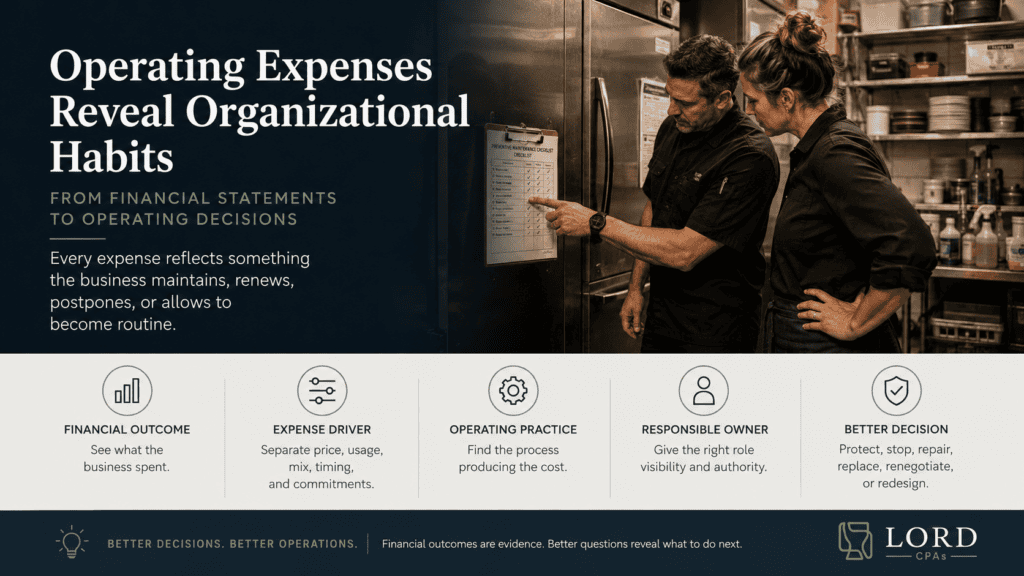
From Financial Statements to Operating Decisions — Part Five
A restaurant’s income statement usually presents operating expenses as a list of numbers.
Repairs and maintenance.
Utilities.
Credit-card processing fees.
Cleaning supplies.
Smallwares.
Technology.
Marketing.
Insurance.
Professional fees.
Each account tells leadership how much the restaurant spent during the period.
That is useful for financial reporting.
But it is not enough for operating a restaurant.
When operating expenses exceed budget, the direction management receives is often equally broad:
“Control expenses.”
“Reduce overhead.”
“Cut unnecessary spending.”
Those may be legitimate objectives. But they are not operating instructions.
An operating-expense account is the accumulated financial result of decisions made throughout the business: what was purchased, what was renewed, what was maintained, what was postponed, what was used, what was standardized, what was allowed to accumulate, and what became routine without anyone deliberately deciding that it should.
The financial statement tells us what the restaurant spent.
The operating system needs to tell us why.
Operating Expenses Are Different—but the Same Principle Applies
In the previous articles in this series, we examined three major sections of a restaurant’s profit and loss statement.
Revenue is the result of guest demand and average spend.
Cost of goods sold is the result of purchasing, receiving, recipes, yields, portions, inventory, waste, pricing, and product mix.
Labor cost is the result of hours, wage rates, role deployment, productivity, and the capacity required to serve demand.
Operating expenses work the same way in one important respect:
The financial result is downstream from the operating system.
But operating expenses are not one system.
They are a collection of systems supporting the restaurant:
- The equipment-maintenance system
- The facility-management system
- The purchasing and approval system
- The technology system
- The marketing system
- The risk-management system
- The vendor-management system
- The professional-support system
- The accounting and financial-reporting system
That is why “reduce operating expenses” is rarely a useful instruction.
There is no single operating-expense lever.
Each account must be traced back to the activity, commitment, process, and decision that created it.
Why Operating-Expense Percentage Is a Weak Operating Metric
Restaurants commonly evaluate operating expenses as a percentage of revenue:
Operating Expenses ÷ Revenue = Operating-Expense Percentage
That calculation is useful for budgeting, benchmarking, and understanding the restaurant’s overall cost structure.
But it does not explain how the expenses were managed.
Suppose a restaurant generates $500,000 in revenue and reports $100,000 in operating expenses:
$100,000 ÷ $500,000 = 20.0%
The following month, operating expenses remain exactly the same, but revenue declines to $450,000:
$100,000 ÷ $450,000 = 22.2%
Operating-expense percentage increased by more than two percentage points.
But spending did not change.
The apparent deterioration came entirely from the denominator.
The opposite can also happen. Sales growth can make operating-expense percentage appear healthier even when the restaurant has not improved purchasing, maintenance, technology management, or any other underlying practice.
The percentage is an outcome.
It is not a diagnosis.
Before asking a manager to reduce operating-expense percentage, leadership needs to determine whether the change came from expenses, revenue, or both.
Start by Separating What Changed
For most operating-expense accounts, the first useful question is not:
“Why are we over budget?”
It is:
“What changed?”
Depending on the account, the financial result may be influenced by:
- Price or rate
- Quantity or usage
- Transaction volume
- Sales-channel mix
- Operating hours
- Contract terms
- Fixed commitments
- Timing and accruals
- Coding or allocation
- One-time events
- Deferred decisions from earlier periods
A useful starting framework is:
Operating Expense = Activity-Driven Cost + Committed Cost + Timing and Unusual Items
Not every account will contain all three components.
Utilities may be driven primarily by rates and consumption.
Credit-card fees are influenced by card sales, transaction volume, card type, processing terms, and technology configuration.
Rent is largely a contractual commitment.
Repairs may be routine, preventive, emergency, or the delayed consequence of earlier maintenance decisions.
The account balance becomes useful only when management separates those realities.
Repairs and Maintenance Reveal What the Business Protects
Repairs and maintenance are often treated as expenses to minimize.
That can be dangerous.
A low repair expense may indicate reliable equipment and disciplined maintenance. It may also mean the restaurant is postponing necessary work.
A high repair expense may indicate poor equipment care. It may also reflect responsible preventive maintenance, an aging facility, a major repair that avoided replacement, or an honest recognition of costs that had previously been deferred.
The P&L cannot distinguish among those possibilities.
Leaders need to ask:
- Was the work preventive or emergency?
- Which asset required service?
- Has the same problem occurred before?
- How much operating time was lost?
- Was recommended maintenance completed?
- Is the equipment being used correctly?
- Are repair records available?
- Would replacement now cost less than continued repair and disruption?
- Was the expense anticipated in the budget or capital plan?
Useful measures may include:
- Preventive-maintenance completion
- Emergency service calls
- Repeat repairs by asset
- Equipment downtime
- Repair spending by asset or location
- Maintenance performed versus scheduled
- Estimated replacement date
- Repair-versus-replacement cost
The objective is not the lowest possible repair expense.
It is reliable equipment, safe operations, and a maintenance rhythm that prevents avoidable disruption.
Utilities Reveal How the Facility and Equipment Are Being Used
Utility expense appears as a dollar amount, but the amount is produced by at least two major drivers:
Utility Cost = Usage × Rate
A higher electricity bill may come from a rate increase, greater consumption, or both.
Consumption may change because of:
- Longer operating hours
- Higher guest volume
- Weather
- Heating or cooling settings
- Refrigeration performance
- Kitchen-equipment efficiency
- Leaks
- Ventilation and exhaust usage
- Equipment left operating unnecessarily
- Changes in the building or service model
Management should review actual consumption whenever possible rather than relying only on dollars.
If expense increased because rates changed, telling employees to “use less electricity” may not address the cause.
If usage increased despite stable operating hours and volume, the restaurant may need to investigate equipment, operating practices, or facility conditions.
Depending on the concept, useful measures may include:
- Electricity, gas, or water usage
- Utility cost per operating hour
- Utility usage per cover
- Utility cost per square foot
- Usage compared with the same season last year
- Rate variance versus usage variance
- Unusual consumption outside operating hours
These measures should identify material patterns—not encourage employees to sacrifice comfort, safety, cleanliness, or food quality to improve a utility percentage.
Supplies, Smallwares, and Disposables Reveal Operating Design
Supplies and smallwares often appear to be simple purchasing accounts.
They are not.
The result may be influenced by:
- Guest counts
- Takeout and delivery volume
- Product specifications
- Vendor pricing
- Ordering frequency
- Par levels
- Breakage
- Loss
- Storage practices
- Inconsistent purchasing
- Changes in the service model
- Employees substituting one item for another
- Items being coded to different accounts or locations
For disposables, a useful starting metric may be:
Disposable Cost per Off-Premise Order = Disposable Expense ÷ Takeout and Delivery Orders
For guest-facing or service supplies, cost per cover may be more relevant.
Those measures help separate higher business activity from higher cost per unit of activity.
If takeout orders increase, total packaging expense should probably increase. That is not necessarily a problem.
The better questions are:
- Did packaging cost increase in proportion to order volume?
- Did unit prices change?
- Did the restaurant change specifications?
- Are employees using more items per order than intended?
- Does the packaging protect quality and the guest experience?
- Does the off-premise channel generate enough contribution to support its packaging and commission costs?
The objective is not to purchase the cheapest possible supply.
It is to use the right product, in the right amount, through a process that supports service without unnecessary waste.
Merchant Fees and Delivery Commissions Follow Transaction Decisions
Credit-card fees and delivery commissions are often categorized as operating expenses, but they are closely connected to revenue and channel mix.
Credit-card expense may be influenced by:
- Card sales volume
- Number of transactions
- Average transaction size
- Card type
- Online versus in-person payments
- Processing terms
- Gateway and software fees
- Chargebacks
- Tips processed through the system
- Additional services included in the contract
A useful outcome measure is the effective processing rate:
Credit-Card Fees ÷ Card Sales = Effective Processing Rate
If the rate changes, management can then determine whether the cause was pricing, card mix, transaction behavior, configuration, or an additional fee.
Delivery commissions require a similar review.
The restaurant should understand:
- Orders by delivery channel
- Average order value
- Commission per order
- Packaging cost
- Refunds and errors
- Incremental labor requirements
- Contribution margin
- Whether delivery orders use otherwise available capacity or displace more valuable demand
More delivery sales do not automatically mean healthier revenue.
The channel needs to be evaluated as an operating and economic system.
Technology Expense Reveals How Recurring Commitments Accumulate
Technology expenses rarely become excessive because of one dramatic purchase.
They accumulate.
A scheduling system is added.
Then an inventory platform.
Then online ordering.
Then a reservation system.
Then guest-feedback software.
Then another reporting tool.
Each may have been reasonable when approved. Over time, however, the restaurant can develop overlapping systems, unused features, inactive users, and contracts that renew automatically because no one owns the review.
Technology should be evaluated based on both cost and operating value.
Leaders should ask:
- Which process is this system intended to support?
- Is the team actually using it?
- Are we paying for inactive locations or users?
- Does another platform perform the same function?
- Does the system improve accuracy, visibility, capacity, or guest experience?
- Has it reduced manual work—or merely added another place to enter data?
- Who owns the relationship and renewal?
- When is the notice date?
- What would stop working if the system were removed?
Useful measures may include:
- Technology cost per location
- Cost per active user
- Adoption or utilization
- Duplicate capabilities
- Manual hours reduced
- Contract renewal dates
- Support issues and downtime
- Data integration and reporting reliability
A software subscription is not justified merely because the restaurant purchased it.
Its value depends on whether it becomes part of a healthy operating process.
Marketing Expense Should Be Connected to a Purpose
Marketing expense is often evaluated as a percentage of sales.
That is not enough.
A campaign should begin with a purpose.
Is the restaurant trying to:
- Introduce the concept to new guests?
- Increase traffic during a weak daypart?
- Promote an event?
- Build repeat visits?
- Introduce a new menu?
- Grow catering?
- Strengthen direct ordering?
- Reduce dependence on third-party platforms?
- Reengage guests who have not returned?
- Build long-term brand awareness?
The appropriate metric depends on that purpose.
Relevant measures might include:
- Reservation or order conversion
- New-guest acquisition
- Repeat-guest frequency
- Email or loyalty engagement
- Event attendance
- Catering inquiries
- Sales by promoted item
- Demand during the targeted daypart
- Direct versus third-party orders
- Contribution generated by the campaign
Perfect attribution is not always possible. Restaurants should not pretend that every guest decision can be traced to one advertisement.
But the absence of perfect information does not justify spending without a stated objective.
Marketing becomes more useful when leadership knows what behavior it is trying to influence and what evidence would indicate progress.
Professional Fees Reveal Complexity, Risk, and Capability
Accounting, legal, human-resources, technology, consulting, and other professional fees can increase for very different reasons.
An increase may represent:
- A deliberate strategic project
- Support for growth
- Improved financial reporting
- Tax planning
- Legal protection
- System implementation
- Leadership development
- Cleanup of earlier errors
- Repeated rework caused by weak internal processes
- Responsibilities that were never clearly assigned
- A temporary need for specialized expertise
These are not economically equivalent.
Professional support should not be evaluated solely by asking whether the hourly rate is high.
Leadership should distinguish among:
- Recurring support
- One-time projects
- Remediation or cleanup
- New capability being built
- Preventable rework
The restaurant should understand what the engagement is meant to accomplish, whether the scope is clear, what internal participation is required, and whether the work leaves the organization more capable afterward.
A low professional-fee account is not automatically a sign of strength.
It may mean the restaurant is postponing decisions, accepting avoidable risk, or asking internal employees to carry responsibilities for which they do not have the time, information, or expertise.
Fixed Does Not Mean Unmanaged
Some operating expenses are relatively fixed in the short term:
- Rent
- Insurance
- Licenses
- Property taxes
- Equipment leases
- Waste removal
- Pest control
- Security
- Contracted services
A location manager may have little ability to change these expenses during the current month.
That does not make them irrelevant.
It means the decision belongs at a different level and follows a different timeline.
Rent is influenced when leadership selects a site, negotiates a lease, renews the agreement, expands the space, or decides whether the location remains economically viable.
Insurance is influenced when coverage is selected, risks are managed, claims occur, and the policy renews.
Contracted services are influenced when specifications, frequency, vendors, pricing, and renewal terms are established.
A good operating system gives the expense to the stakeholder who can actually influence it.
Holding a general manager accountable for a lease negotiated years earlier creates pressure without authority.
A Variance Is a Signal—Not an Accusation
When an operating expense exceeds budget, the variance should begin an inquiry.
A useful review follows a disciplined sequence.
1. Confirm the Financial Information
Check the account coding, timing, accruals, allocations, and comparison period.
A large variance may be caused by an annual invoice, a delayed bill, a missing accrual, or an expense assigned to the wrong location.
2. Identify the Driver
Separate price, usage, volume, mix, timing, fixed commitments, and unusual events.
Do not assume the cause from the account name.
3. Understand the Operating Context
What changed in guest volume, hours, equipment, channels, service, staffing, or facility conditions?
The people closest to the work may already know what the financial statement cannot show.
4. Identify the Responsible Role
Who can influence the underlying process?
Does that person have access to the information, authority, budget, and vendor relationships needed to act?
5. Choose the Appropriate Decision
The answer may be to:
- Protect the expense
- Stop the expense
- Renegotiate it
- Standardize purchasing
- Correct usage
- Repair an asset
- Replace an asset
- Change a vendor
- Improve a process
- Reclassify or accrue the cost properly
- Accept the expense intentionally
6. Return to the Result
After the decision is implemented, determine whether the operating system improved.
The objective is not merely to move a cost into another account, location, employee workload, or future period.
One Percentage Can Contain Several Different Stories
Suppose a restaurant reports:
- Revenue of $500,000
- Operating expenses of $100,000
- Operating-expense percentage of 20.0%
The following month reports:
- Revenue of $450,000
- Operating expenses of $105,000
- Operating-expense percentage of 23.3%
At first glance, operating expenses appear to have deteriorated by 3.3 percentage points.
But most of that movement came from lower revenue.
If expenses had remained at $100,000, the percentage still would have increased to 22.2%.
The remaining $5,000 increase might include:
- An emergency refrigeration repair
- An annual technology renewal
- Higher utility usage
- Increased delivery commissions from a change in channel mix
Each component requires a different decision.
The restaurant may need to improve preventive maintenance.
It may need a technology-renewal calendar.
It may need to investigate utility consumption.
It may need to evaluate delivery-channel contribution.
And it still needs to understand why revenue declined.
Telling the general manager to “cut three points of operating expense” would combine several unrelated issues and provide no responsible direction.
Multi-Location Comparisons Can Reveal Inconsistent Systems
Multi-location restaurant groups have an additional opportunity.
When similar locations report materially different operating expenses, leadership can compare the systems behind them.
But the comparison must be fair.
Differences may come from:
- Building age and condition
- Local utility rates
- Lease structure
- Sales volume
- Channel mix
- Hours of operation
- Equipment
- Service model
- Account coding
- Shared-cost allocations
- Timing of invoices
- Responsibilities handled centrally at one location and locally at another
Once those factors are understood, location comparisons can reveal valuable practices.
One restaurant may have a stronger preventive-maintenance rhythm.
Another may use fewer technology platforms.
Another may manage supplies with consistent specifications and par levels.
Another may appear efficient only because invoices are missing, costs are coded elsewhere, or employees are compensating for an underfunded system.
The financial difference is a starting point.
The operating practice explains whether the difference is healthy and repeatable.
Better Metrics Reveal the Habit
Depending on the restaurant, useful operating-expense measures may include:
Repairs and Maintenance
- Planned versus emergency work
- Repeat failures
- Downtime
- Preventive-maintenance completion
- Repair cost by asset
Utilities
- Usage by utility
- Rate versus usage variance
- Cost per operating hour
- Usage per cover
- After-hours consumption
Supplies and Disposables
- Cost per cover or order
- Unit-price changes
- Quantity purchased
- Breakage or replacement frequency
- Spend by channel
Merchant Fees and Delivery
- Effective processing rate
- Cost per transaction
- Commission per delivery order
- Contribution by channel
- Chargebacks and refunds
Technology
- Cost per location or user
- Active usage
- Duplicate functionality
- Renewal dates
- Manual work reduced
Marketing
- Spending by objective
- Conversion
- New and repeat guests
- Targeted daypart demand
- Campaign contribution
Professional Fees
- Recurring support
- Projects
- Cleanup and remediation
- Preventable rework
- Capability created
The purpose is not to create a dashboard for every expense account.
The purpose is to identify the few measures that help leadership understand why a material cost is changing and which decision should follow.
Build an Operating-Expense Review Rhythm
A productive monthly review does not require interrogating managers about every line on the P&L.
It should focus attention where the result is material, unusual, recurring, or strategically important.
A useful rhythm may include:
- Review material variances against budget, prior periods, and recent trends.
- Confirm accounting accuracy and timing.
- Separate price, usage, mix, volume, commitment, and unusual items.
- Ask the people closest to the work what changed.
- Identify the process and stakeholder responsible for the driver.
- Decide what should be protected, changed, stopped, repaired, replaced, or accepted.
- Assign the action and a follow-up date.
- Return to the result and determine whether the system improved.
Quarterly or annual reviews can address decisions that do not belong in a monthly management meeting:
- Vendor agreements
- Technology renewals
- Insurance
- Preventive-maintenance plans
- Equipment replacement
- Facility needs
- Professional-service scopes
- Purchasing standards
- Approval thresholds
- Multi-location consistency
This creates a decision rhythm instead of a recurring reaction to surprises.
Stewardship Is Not the Same as Austerity
Operating-expense discipline matters.
Every recurring commitment consumes resources that cannot be used elsewhere.
Waste, unused subscriptions, uncontrolled purchasing, preventable repairs, and unclear vendor relationships reduce the restaurant’s ability to invest in its people, guests, equipment, and future.
But responsible expense management is not the same as spending as little as possible.
Some expenses protect:
- Employee capacity
- Food safety
- Equipment reliability
- Facility condition
- Guest experience
- Financial accuracy
- Legal and regulatory compliance
- Data security
- Management capability
- Long-term resilience
Reducing those expenses without understanding their purpose may make the current month look better while weakening the operating system.
The cost often returns somewhere else:
- Emergency repairs
- Lost revenue
- Employee burnout
- Guest complaints
- Rework
- Turnover
- Risk
- Deferred capital needs
- Management time spent compensating for inadequate systems
Good stewardship distinguishes waste from capacity.
It protects what the restaurant truly needs while addressing the habits that consume resources without supporting the business.
Financial Outcomes Are Evidence
At Lord CPAs, we believe financial outcomes do not drive a business.
They provide evidence of how the business is interacting with people, systems, assets, vendors, risks, and decisions.
Operating expenses are especially revealing.
They provide evidence of:
- What the organization maintains
- What it allows to deteriorate
- What it renews without review
- What it purchases without a standard
- What it measures
- What it postpones
- What it protects
- What it expects employees to work around
- What becomes routine without deliberate approval
- Whether responsibility and authority are aligned
A rising expense should not automatically begin with a demand to cut.
It should begin with curiosity.
What changed?
Which driver produced the change?
What purpose does the expense serve?
Who can influence the process?
Is the current pattern intentional?
Is it sustainable?
What should leadership protect, repair, redesign, or stop?
Build Healthier Habits, Not Just Lower Expenses
A restaurant cannot directly manage an operating-expense percentage.
It manages the decisions and systems that eventually produce that percentage.
It can maintain equipment before it fails.
It can monitor actual utility usage.
It can establish purchasing specifications and par levels.
It can evaluate delivery-channel economics.
It can assign ownership for technology renewals.
It can connect marketing spending to a purpose.
It can distinguish strategic professional support from preventable cleanup.
It can give responsibility to people who have the authority and information to act.
It can make recurring commitments visible before they renew.
When those practices improve, the financial outcome often improves with them.
But the deeper benefit is a restaurant that operates with greater clarity, consistency, accountability, and care.
Operating expenses are not merely a list beneath labor and cost of goods sold.
They are the financial record of what the organization repeatedly chooses to maintain, renew, postpone, tolerate, and protect.
The P&L shows the expense.
The operating system reveals the habit.
Lord CPAs helps restaurant and hospitality leaders connect financial results to the operating decisions that produce them. By moving beyond percentages and examining the systems beneath each expense, leaders can protect the resources their businesses need, correct unhealthy patterns, and make better decisions about what comes next.
