
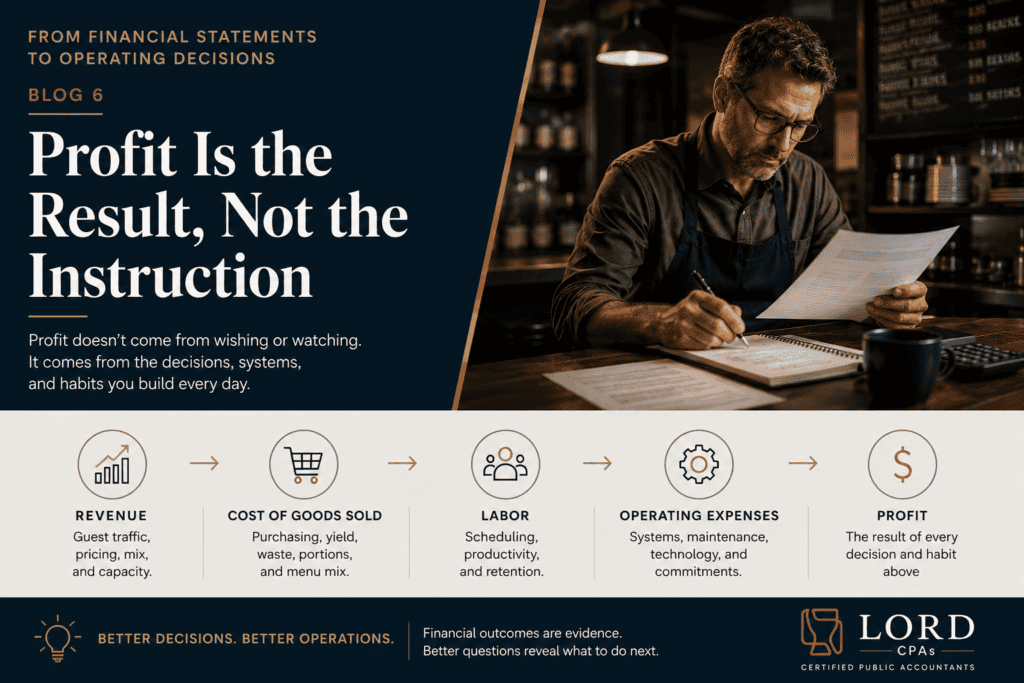
Series: From Financial Statements to Operating Decisions
“Improve profitability.”
It sounds like a reasonable instruction.
It is also nearly useless as an operating instruction.
A restaurant manager cannot walk into a shift and directly increase profit. A chef cannot prep profit. A server cannot sell profit. A purchasing manager cannot order profit. An owner cannot create profit by staring more intently at the bottom line.
Profit is what remains after everything else in the business has happened.
It is the financial result of hundreds of decisions involving guests, employees, purchasing, pricing, scheduling, production, waste, capacity, service, maintenance, marketing, and countless other parts of the operating system.
That makes profit enormously important.
But it does not make profit something a business can manage directly.
The purpose of financial reporting is not simply to tell leaders whether profit was good or bad. It is to help them understand why the result occurred and what operating decisions should come next.
That distinction is at the heart of this entire series.
The Bottom Line Is the End of the Story
A profit and loss statement is arranged from top to bottom.
Revenue comes first.
Then the costs required to produce that revenue.
Then labor.
Then operating expenses.
Eventually, after all of those economic activities have been recorded, we arrive at profit.
There is something instructive about that structure.
Profit appears at the bottom because it is the culmination of everything above it.
Consider a restaurant that experiences a decline in profitability.
That result may have been influenced by:
- fewer covers during historically strong dayparts,
- slower table turns,
- lower beverage attachment,
- excessive discounting,
- menu items priced below their economic requirements,
- unfavorable product mix,
- food waste,
- poor purchasing practices,
- overtime,
- scheduling that does not match demand,
- employee turnover,
- inefficient workflows,
- equipment problems,
- unnecessary subscriptions,
- deferred maintenance,
- or dozens of other operating conditions.
All of them eventually arrive at the same place:
profit.
But knowing that profit declined does not tell us which of those conditions changed.
The financial statement gives us the result.
Management must uncover the story.
Profit Is an Outcome Metric
One of the most useful distinctions leaders can make is between an outcome metric and an operating metric.
Profit is an outcome metric.
It tells us something important about the health of the overall economic system.
Operating metrics help explain how that outcome was created.
For revenue, we might examine:
Covers × Average Spend per Cover
Then we can move deeper.
Covers may be influenced by reservation conversion, seating utilization, table-turn time, repeat guests, daypart demand, order throughput, and available capacity.
Average spend may be influenced by menu pricing, product mix, beverage attachment, appetizer attachment, dessert attachment, discounts, and items per cover.
The same logic applies throughout the income statement.
Food cost may lead us toward yield, waste, purchasing, portioning, recipe adherence, vendor pricing, and menu mix.
Labor may lead us toward labor hours, demand patterns, productivity, scheduling, training, turnover, management structure, and workflow.
Operating expenses may reveal decisions about vendors, facilities, technology, maintenance, marketing, insurance, and administrative complexity.
Profit sits downstream from all of them.
That is why telling a management team to “increase profit” is fundamentally different from helping them identify the operating behaviors that influence it.
One is a desired result.
The other is management.
A Profit Target Still Matters
None of this means businesses should stop budgeting profit or establishing financial targets.
Targets are useful.
They establish expectations about the economic performance the business needs to sustain itself.
A restaurant needs enough margin to service debt, replace equipment, withstand unexpected events, compensate ownership appropriately, invest in its people, fund future growth, and maintain adequate liquidity.
A business that consistently fails to generate sufficient profit eventually loses choices.
Cash becomes tighter.
Maintenance gets deferred.
Hiring becomes harder.
Training gets cut.
Owners become more reactive.
Employees feel the consequences.
Vendor relationships become strained.
The organization’s ability to serve guests and care for its stakeholders begins to deteriorate.
Profitability therefore matters deeply.
But a profit target should function as a destination, not a set of driving directions.
If management is told that the restaurant needs a 10% operating margin, that tells the team where the business needs to arrive.
It does not tell them how to get there.
The next question must be:
What operating conditions would need to be true for that result to occur?
That is where financial management begins.
Move Up the Statement
When profit misses expectations, one of the simplest disciplines is to work backward through the income statement.
Do not begin by asking:
How do we increase profit?
Begin by asking:
Where did actual performance differ from our expectations?
Perhaps revenue is below plan.
Then ask why.
Were covers lower?
Was average spend lower?
Was the problem concentrated in particular locations, days, dayparts, or channels?
Perhaps revenue was strong but gross profit declined.
Then we may need to examine purchasing, product mix, pricing, waste, yield, or recipe economics.
Perhaps gross profit was healthy but labor increased.
Then we need to understand whether labor hours changed, wage rates changed, overtime increased, management structure changed, or productivity declined.
Perhaps prime costs are performing well but operating expenses are expanding.
Then we work through those categories and identify what changed.
Eventually, the vague problem of “profit is down” becomes a much more useful statement:
Friday dinner covers are strong, but weekday lunch traffic has declined.
Or:
Food cost increased because our product mix shifted toward lower-margin items while purchasing prices also increased.
Or:
Labor percentage increased because volume declined faster than scheduled labor hours adjusted.
Those are problems a management team can actually work on.
Do Not Manage the Percentage in Isolation
There is another danger in focusing too aggressively on profit.
Leaders can begin managing percentages without understanding the system underneath them.
Imagine that labor percentage is above target.
The fastest mathematical solution may appear obvious:
Cut labor.
But what happens if those labor hours were supporting the very things that create revenue?
Fewer employees might mean slower service.
Slower service may reduce table turns.
Reduced table turns may reduce covers.
Service quality may decline.
Guests may return less frequently.
Employees may become exhausted.
Turnover may increase.
Training costs may rise.
Revenue may fall further.
The original attempt to improve profitability may ultimately make profitability worse.
The same problem occurs when businesses chase food cost percentages by sacrificing quality, delay necessary maintenance to protect operating expenses, or reduce marketing without understanding whether it is producing demand.
Financial ratios are signals.
They are not instructions.
The job of leadership is to interpret the signal within the context of the operating system.
Sometimes the Right Decision Makes Profit Worse Today
Good financial management also requires accepting an uncomfortable truth:
Not every good decision improves this month’s profit.
A restaurant may need to replace equipment.
Train managers.
Increase wages to retain strong employees.
Repair a neglected facility.
Invest in technology.
Develop a new menu.
Strengthen internal controls.
Hire needed leadership.
Spend money on a marketing initiative.
Close temporarily for renovations.
Any of those decisions may reduce short-term profitability.
That does not automatically make them bad decisions.
A business is not a machine designed to maximize one month’s income statement.
Leadership must consider time horizon.
Some expenses protect today’s operation.
Others build tomorrow’s capacity.
Others reduce risk.
Others improve the guest experience.
Others strengthen the people responsible for delivering that experience.
The financial question is not simply:
Does this increase profit?
A better question is:
Does this investment strengthen the business sufficiently to justify the resources it consumes?
That requires judgment.
And good judgment requires more than percentages.
Profit Should Create Questions, Not Pressure
When financial results are used poorly, they become a source of pressure.
“Sales need to go up.”
“Labor needs to come down.”
“Food cost is too high.”
“We need more profit.”
Those statements can create anxiety throughout an organization without giving anyone useful information about what they should actually do differently.
Numbers become something employees are blamed for rather than something teams learn from.
That is rarely productive.
A healthier management system uses financial outcomes to generate better questions.
Instead of:
Why is labor so bad?
Ask:
Where are labor hours no longer matching demand, and what is causing the mismatch?
Instead of:
Why aren’t we making enough money?
Ask:
Which operating drivers changed, and which of them can we responsibly influence?
Instead of:
How do we cut costs?
Ask:
Which resources are producing value, which are protecting necessary capacity, and which are no longer serving the organization?
The difference may sound subtle.
It is not.
One approach uses financial information as judgment.
The other uses financial information as feedback.
Financial Statements Should Lead Back to Operations
This is the central argument of the From Financial Statements to Operating Decisions series.
Every number on the financial statement came from somewhere.
Revenue came from guests choosing to visit, what they purchased, what the business charged, the capacity available to serve them, and the experience that encourages them to return.
Cost of goods sold came from purchasing, recipes, portions, waste, pricing, product mix, inventory management, and vendor decisions.
Labor came from people, schedules, workflows, management systems, demand, productivity, training, and organizational design.
Operating expenses came from hundreds of choices about how the business supports and maintains itself.
And profit?
Profit is where all of those decisions meet.
That is why the bottom line is valuable.
It summarizes an enormous amount of organizational activity into a single financial result.
But the summary is only the beginning of management analysis.
When the result is different from what we expected, we must move back upward through the organization and find the decisions, behaviors, relationships, and systems that produced it.
Better Profit Comes From Better Decisions
A financially healthy organization does not ignore profitability.
It understands profitability more deeply.
Leaders establish the financial outcomes the business needs and then translate those outcomes into operating realities.
What level of demand do we need?
What capacity can we serve well?
What does our pricing need to support?
What product mix creates both guest value and economic sustainability?
How should staffing respond to demand?
Where is waste occurring?
What resources are strengthening the operation?
Where is complexity consuming money without creating value?
What investments will strengthen future capacity?
Those questions move management away from simply reacting to financial statements and toward intentionally shaping the business that creates them.
That is the real purpose of financial information.
Not merely to report what happened.
Not to pressure people with percentages.
Not to reduce a complicated organization to one bottom-line number.
Financial information should help leadership see more clearly, ask better questions, and make wiser operating decisions.
At Lord CPAs, we believe financial statements are most useful when they help leaders understand the business underneath the numbers.
Profit matters.
But profit is not the instruction.
It is the result of how the business operates.
And when leaders want to change the result, the work begins upstream.
